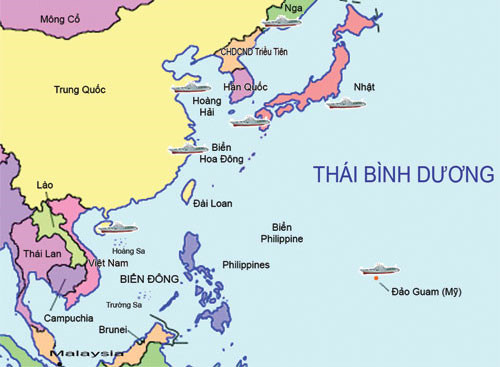
As predicted, the regional economy will be the most dynamic development comparing to the world in the 21st century. Currently, the Pacific Rim, accounting for about 61% of world GDP; 48% of international trade; over 48% of funds in foreign direct investment of the world ... Because of the importance, large countries are very focused on the Pacific Rim, and the strategy for the region in order to gain a strategic advantage their strategy. According to international analysts, the highlights in strategy that the major countries direct toward the Pacific Rim region is not only cooperate but also compete, intense competition in the sector, firstly on business fall; Through diverse and multilateral policy of relations to take advantage and mutual restraint, enhance the influence, the power to govern for the region. That characteristic has a significant impact on security and stabilityof this region.
- Strategy of the United States: In a global strategy, the White House is considered the Pacific Rim as a regional strategy, a regional politics, direct relationship to the national security and the world leadership of US. G.W.Bush US President has repeatedly stated, to the United States today, there is no more important area then the Pacific Rim region. America's overarching goal in the Pacific Rim is to play a dominant role, to protect the vital interests of the countries in the region and to implement the global strategy. US implement the Pacific Rim strategy basing on 3 main pillars: security, economic and foreign policy. In terms of security, in order to maintain security and stability in the Pacific Rim, the White House reinforces the traditional military alliance with Japan, Korea, Australia-li-a, Philippines and Thailand; Regarded the alliance with Japan as "cornerstones" expand and strengthen military relations and security with other countries and regional security structure, to influence and form "the centipede legs" serving for US strategy in the region. At the same time, strengthen the military power and modernization of the armed forces stationed in the front, the military, formed the military's strategic layout, to control, to restrain the entire region , do not let the other countries challenge to American leadership. Economically, the last time, two-way trade turnover, US investment in the region rose faster and higher than other areas. Currently, the US is focused on two directions: First, continuing in strengthening the economic cooperation with other countries, particularly countries considered as major markets, such as Japan, China, ASEAN ... Second, promoting the leading role of the regional organizations, such as economic cooperation forum CA-Pacific (APEC), to promote market opening, liberalization of trade, investment and economic dominant economic region. Besides, the US also strengthen policies to prevent, such as establishing tariff barriers, application of intellectual property law, financial sanctions .., to protect the domestic market and to restrain the economics of other country. On foreign policy, taking the guise of "anti-terrorism", "democracy", "human rights", the US implementation of the policies involved in the region. In relationships, respect strategies "carrot and stick", dealing with the country under the "double standards", especially with countries that the US is "incurable"; The most evident is how to resolve the nuclear issue of the DPRK. Assessment of US strategy, analysts said that it is a strategy to promote the overall strength of the US to achieve its goals in the region; But that strategy is not consistent with a Pacific Rim which has a lot of changes; So, firstly, that strategy still thinking of a period of "cold war", is to take the power to "prevent and restrain" other countries, in order to protect the security and interests of its country. That makes the conflict between the United States and other countries, including allies, more and more deep and complicated. Second, US military strengthening factor promoting arms race, threatening the security and stability of the region, public opinion was opposed.
- Strategy of China: In the country's development strategy, China is considered the Pacific Rim region as a crucial strategy for the security and the development of China. The objective is also China's policy towards the Pacific Rim which is to strengthen the cooperation with other countries, to build the Pacific Rim into a peaceful region, cooperation and development area. Economically, after 15 years of the continuously highest growth (around 10%/year), China has become an important economy, a potential partner for the countries in the region and the world. But the development also poses the urgent requirements, requires China to strengthen further expansion of economic cooperation with other countries to attract foreign investment, increase two-way trade turnover and market expansion into the region and internationally. In cooperation, the China focus on promoting the strengths in technology, the cost of products to consumers goods dominate the market competition. In terms of security, there is a vast country thousands of kilometers borderline meters adjacent to dozens of countries, should China attaches great importance to the negotiations with neighboring countries to delineate borders, settlement territorial disputes left over by history, strengthen broaden cooperation, building national borders of peace, stability, serve the construction tasks, development. On the other hand, China supports and actively involved in the security structures in the region, particularly the Shanghai Cooperation Organization (SCO), to enhance the strength, security, national interests and respect deal with scams enclosure, Chinese restraint of some Western powers. As for the Taiwan issue, China's stated stance, peaceful settlement in a spirit of national reunification, "one country two systems", similar to the model of Hong Kong; resolutely oppose foreign interference in the Taiwan issue. On foreign policy, China's policy of implementing a foreign policy of independence, self-reliance, openness, diversification and multilateralization of international relations, based on five principles of peaceful coexistence that China has set out, in order to creating an environment of peace and stability for development. China is serous in comprehensive cooperation with neighboring countries, the traditional friendly countries, and countries in the region. Last time, China and Vietnam have continuously promoted friendly relations and comprehensive cooperation to a new level, according to the 16-word motto "friendly neighborliness, comprehensive cooperation, long-lasting stability, looking towards the future ". The two countries committed to building up the relationship forever are "good neighbors, good friends, good comrades and good partners". In relations with the US and Japan, China's policy agree in setting aside what the historical existence left; disagreements limited, leveraging the similarities, the common interests to expand mutually beneficial cooperation. China is also actively promoting its role in solving regional issues, particularly in resolving the nuclear crisis on the Korean peninsula, through enhancing the position and important role of China in the area and international arena. However, China is facing significant challenges. First, concerning about the rise of China, many Western powers have deemed China as a "strategic competitor" and implementing the control policies which prevent China in all fields. Second, the strengthening of China's military power makes many countries be aware, fears for the Chinese intention "fill the power vacuum" in the Pacific Rim, it makes strategic competition between the major powers increasing fiercely.
- Strategy of Japan: As an economic power, Japan is adjusting the policy to strengthen its position about the politics, military, region and international arena. Economically, Japan continues to expand its influence in the region through economic cooperation, especially in major markets such as China, ASEAN. Security, Japan still considered military alliance with the United States is fundamental for national security and strengthening the influence of Japan in the region. Recently, Japan has decided to upgrade the Defense Agency to the Defense Ministry. The leaders of Japan also public the advocate amending the Constitution that the Japanese military can participate in military operations outside the national territory. Strengthen security cooperation with the US, especially in building a missile defense battlefield system, which they thought to deal with potential threats, particularly from North Korea. Externally, Japan advocates the reform of the United Nations (UN), actively motor the US and other countries in the region to support Japan becoming new permanent member of the UN Security Council. However, Japan support the US request requiring EU further arms embargo against China, bringing Taiwan into the scope of Japan military warfare; however, it has been strongly opposed from China and be considered as the violation of Chinese sovereignty, which ruin the relationship. Moreover, the new policy of the Japanese military caused fear to public in many countries about the return of militarism. According to analysts, with such policies, Japan is creating difficulties for itself in implementing regional and international ambition.
- Strategy of Russia: The Russian leader said that the Pacific Rim is the region with strategic importance for Russia, especially now, Russia needed no "counterweight" to deal with scams and the competition for influence action, siege, controlled by the military to Russia of US and NATO. Currently, Russia is focusing on strengthening cooperation with other countries, especially neighboring countries, countries with traditional ties, such as China, India, Central Asian countries. In relations with the US, Russia still taken as the main cooperation, but resolutely oppose US interfere in internal affairs of Russia. Russia is focusing on the strengths, responsibilities in improving, elevate the relationship and quality of cooperation within region where Russia participated, such as SNG, SCO, meeting the expectation of the Member States as well as the requirements of the new situation, to protect the security, national interests and promote the role, its important position in the region.
Pacific Rim region is rich in economic potential and is standing in front of tremendous advantages for the development, but also multi available conflicts, ethnic conflict, religion, territorial sovereignty disputes, natural resources, splittism, terrorism, state of nuclear proliferation ... here there are many potential "hot spots", threats to security, stability in the region and the world. There are many opinions blame that maintaining security environment, stability and cooperation is the "key" for the development of the region in recent years, as well as in the future. This is suitable with the trend of peace, cooperation, development of the times, is the urgent desire for the development of national-ethnic. Therefore, more than ever, countries, especially the major countries need deep awareness about the importance, benefit and responsibility of security, area stability, strengthening in expanding region, inter-regional, international, with an absolutely compliant spirit of international law, the UN Charter, respect for independence, sovereignty, territorial integrity, non-interference in internal affairs of other states; not threaten the use of force in international relations; resolve disagreements, disputes through peaceful negotiations; equal cooperation and mutual benefit, to cope with the challenges, risks, building the Pacific Rim, peace, stability, cooperation and development.
Source: tapchiqptd.vn